Poster Presentation Australian and New Zealand Obesity Society Annual Scientific Conference 2026
Sustained weight loss and diet quality improvements following a meal replacement intervention programme: a 12-month pre–post evaluation. (#104)
Background: Diets using meal replacements (MR) have demonstrated greater effectiveness for weight loss than standard behavioural programmes[1]. Despite this, MR are infrequently prescribed, largely due to concerns that behavioural change is not sustained after completion[2]. This study evaluated 6 and 12-month outcomes of a MR intervention for adults with obesity addressing this evidence gap.
Methods: Participants commencing a 12-week diet using MR between 2021 and 2025 with available 6-month follow-up weight data were included. Outcomes included weight, comorbidities and the following characteristics; dietary behaviours (food habits questionnaire, grazing questionnaire), physical activity (Baecke questionnaire), eating behaviour/self-efficacy (EDE-Q, WELQ), and psychosocial wellbeing (PROMIS, Weight Bias Internalization Scale). Changes from baseline to 6 and 12-months were assessed using t-tests, while predictors of weight change were examined using linear mixed-effects modelling.
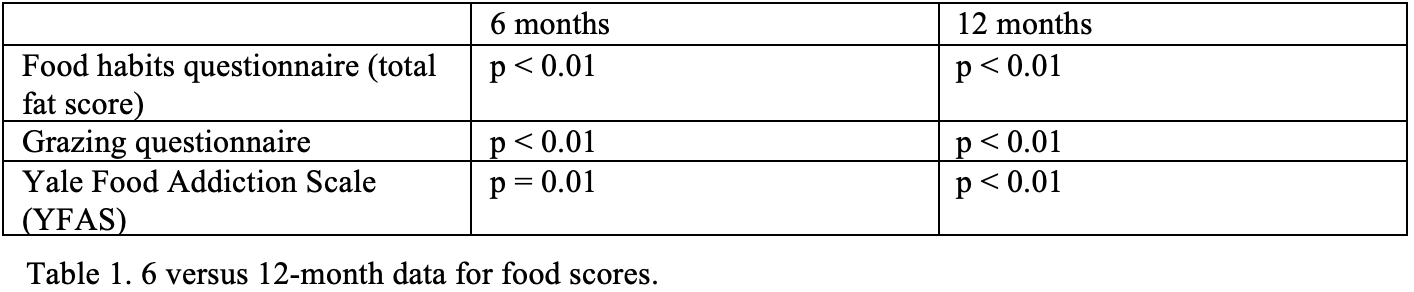
Results: 96 participants were included with mean age 53.3 years and 70% female. Mean weight loss was 8.5% at 6 months (n=96) and 5% at 12 months (n=55). Food habits, grazing, and food addiction scores all improved by 6 months and were maintained at 12 months (Table 1). The most notable improvement in self-efficacy and physical activity was at 12 months (p < 0.05). Dietary fat-reduction habits worsened at 12 months, while actual food intake improved substantially (with reduced discretionary food). A linear mixed model found total baseline characteristics explained only 8.8% of weight-loss variance, with only baseline self-efficacy (WELQ) statistically significant (p = 0.02).
Conclusion: The MR diet achieved durable weight loss and psychosocial gains, supporting greater clinician confidence in MR utilisation.
- [1] Astbury, N. M., Aveyard, P., Nickless, A., Hood, K., Corfield, K., Lowe, R., & Jebb, S. A. (2018). Doctor Referral of Overweight People to Low Energy total diet replacement Treatment (DROPLET): Pragmatic randomised controlled trial. BMJ, 362, Article k3760. https://doi.org/10.1136/bmj.k3760
- [2] Gripeteg, L., Karlsson, J., Torgerson, J., & Lindroos, A. K. (2010). Predictors of very-low-energy diet outcome in obese women and men. Obesity Facts, 3(3), 159–165. https://doi.org/10.1159/000314655